VOL. I · NO. 1 · FIRST ISSUE❖JUNE 1, 2026❖HAITIANBUSINESSJOURNAL.COM
Read this page in English, Français, or Kreyòl
Live page translation
T H E
HAITIAN
BUSINESS
JOURNAL
Economy · Trade · Investment · Diaspora · DevelopmentHarold J. Eustache Sr., Esq. · Editor in Chief
Culture & Travel · Sud-Est Department · Vol. I, No. 2
Destinations & Culture
Jacmel: Haiti's Pearl of the South
Where art, history, and the sea converge — Jacmel is a city of elemental beauty and a revelation for the Haitian diaspora and international travelers alike.
By The Editors of the Haitian Business Journal · July 2026 Issue · Vol. I, No. 2
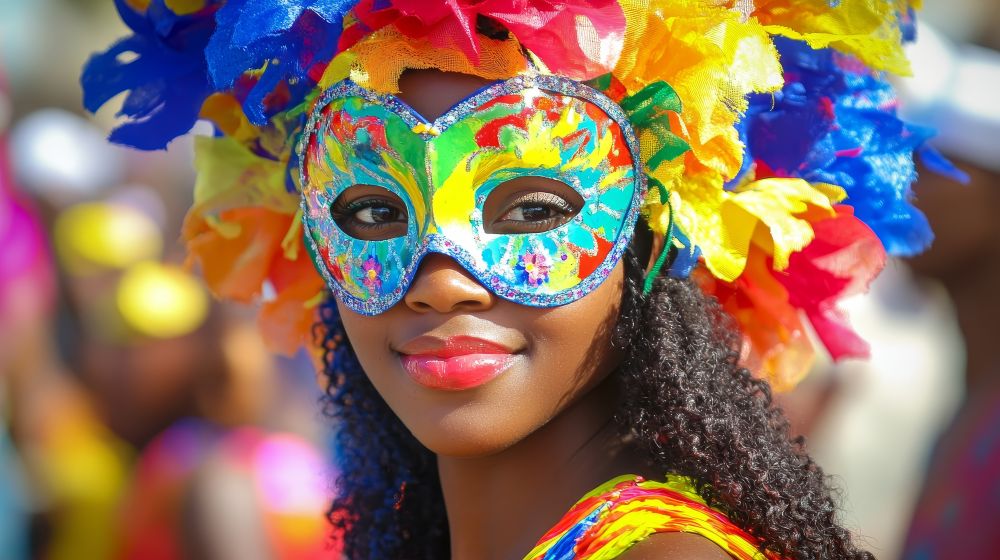
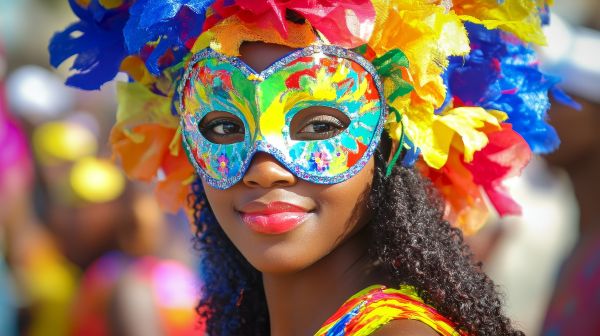
A reveler in hand-painted mask and feathered headdress at the Jacmel Carnival — the artistry that has made the city's Mardi Gras celebration one of the most admired in the Caribbean.
It begins with water. The name itself tells you so. In the language of the Taíno people who first called this land home, Jacmel derives from Yaquimel — "Clear Water." Stand at the edge of Jacmel Bay on a sun-drenched February morning, with the jade hills of the Tiburon Peninsula cascading behind you and the Caribbean stretching before you in an unbroken sweep of turquoise, and you understand why that first name has never really left. Jacmel is a city of elemental beauty — of water, color, stone, and story — and it may be the most singular destination in all of Haiti.
A Geography Drawn by Providence
Tucked along Haiti's southern coast roughly 25 miles southwest of Port-au-Prince as the crow flies — though the road, winding through mountain passes and verdant valleys, makes it feel like a journey to another era — Jacmel has long occupied a special place in the Haitian imagination. It is at once a city of the past and a living creative laboratory, a place where colonial architecture and artisanal genius coexist on the same cobblestone street, where Mardi Gras becomes high art, and where the hospitality of the Jacmélien people feels less like a tourism industry and more like an ancestral practice.
Geography, in Jacmel's case, feels less like an accident of tectonics than a deliberate act of curation. The city sits on a hillside overlooking the broad arc of Jacmel Bay, a natural harbor framed by the green shoulders of mountains that protect it from the prevailing winds. The Tiburon Peninsula extends westward like a beckoning arm, while to the east, the coast gives way to the beaches of Cayes-Jacmel — Raymond des Bains, Kabik, Ti Mouillage — each one a study in the particular blue that the Caribbean reserves for its most favored shores.
The city covers approximately 171 square miles of terrain that shifts dramatically from the sea: tropical lowlands thick with cacao and mango give way to cooler highlands where coffee bushes still grow in terraced rows, their cherries ripening slowly in mountain air. The Gosseline River flows toward the bay, shaping the western boundary of the historic district and providing, historically, the lifeblood of community — washing day, market day, the rhythm of water against stone that has ordered Jacmelian life for generations.
"In Yaquimel — Clear Water — Haiti has preserved a city that is, in every sense, a mirror of its finest self."
Founded on Commerce, Built on Beauty
Jacmel's story begins in 1698, when French colonists established a settlement that would quickly grow into one of the Caribbean's most important trading ports. Sugar, coffee, and cotton flowed through its harbor, and the wealth they generated left a physical legacy that remains, against all odds, partially intact today: the grand colonial mansions of Rue du Commerce and its neighboring streets, their facades painted in the particular palette — ochre, terracotta, dusty rose, and cream — that gives old Jacmel the air of a Caribbean version of New Orleans' French Quarter.
That architectural comparison is not coincidental. Scholars and historians have long noted that Jacmel's distinctive colonial style — characterized by deep wraparound verandas, intricate wrought-iron balustrades, tall shuttered windows designed to capture the sea breeze, and internal courtyards open to the sky — directly influenced the architectural vocabulary of New Orleans and other Gulf Coast cities where Haitian and Caribbean influence ran deep. Walk the cobblestone streets of old Jacmel and you are walking through a living design archive, a predecessor to some of the most celebrated streetscapes in North America.
The 19th-century iron market — a prefabricated structure imported from Belgium in 1895, its green-painted ironwork pavilions now a landmark of the city center — stands as testament to Jacmel's former cosmopolitan ambitions. So too does the Manoir d'Alexandra, rebuilt after the great fire of 1896, and the many merchant homes that line Rue du Commerce, their ground floors designed as counting houses and warehouses, their upper floors as the private quarters of the families whose fortunes rose and fell with the coffee trade. Today, many of those historic mansions have been reimagined as artisan studios, galleries, and boutique guesthouses — a fitting transformation, since Jacmel's wealth was always ultimately cultural rather than merely commercial.
The Economic Soul of a Creative City
If Jacmel's colonial economy ran on coffee and sugar, its contemporary economy runs on creativity — a more sustainable and, arguably, more dignified foundation. The city's 19th-century exports once filled the holds of European merchant ships; today, its artisanal work fills galleries from Miami to Montreal, and its papier-mâché masks have found their way into museum collections around the world.
200+
Papier-mâché artisans working in and around Jacmel
40K
Approximate population of the city of Jacmel
2014
UNESCO Creative City of Crafts and Folk Arts designation
The artisan economy is no small thing. Their work ranges from the miniature to the monumental — intimate masks sold in the craft markets to towering carnival figures that require months of construction and entire families to carry through the streets. The Macy's Heart of Haiti program, developed through a partnership with the Clinton Bush Haiti Fund, brought Jacmelian papier-mâché craftsmanship to American department store shelves, offering artisans a direct commercial lifeline to the world's largest consumer market.
Beyond papier-mâché, Jacmel's creative economy encompasses painting — the city has produced a distinct school of Haitian art with its own visual vocabulary — sculpture, handwoven baskets and textiles, artisanal jewelry, and furniture. The city hosts a nationally recognized music and film school. The Jacmel Film Festival, established in 2004, and the international Jacmel Music Festival, launched in 2007, have added cultural tourism infrastructure that positions the city as a destination rather than merely a port.
In 2014, UNESCO formally recognized what the Jacméliens had always known, designating the city a Creative City of Crafts and Folk Arts — a distinction that places it in the company of cities recognized globally for the depth and originality of their artisanal traditions. The city's historic district has also been proposed as a UNESCO World Heritage Site, an honor that, if granted, would cement Jacmel's place on the international cultural itinerary.
"Nearly 200 papier-mâché artisans transform water, newspaper, and imagination into works that speak the language of Haiti's soul."
Cultural Heritage
Mardi Gras: Where Haiti's Imagination Takes to the Streets
There is no preparation adequate for the Jacmel Carnival. You can read about it. You can study the photographs — the jaguar mask in its tart red and yellow, the searching eyes of the crocodile, the enormous sculptural figures that tower over the parade route. You can listen to accounts from those who have stood in the crowd as the procession passes. And then the reality arrives, and it is larger than all of it.
The Jacmel Carnival — Haiti's prelude to Mardi Gras, held each February in the weeks preceding Ash Wednesday — is considered by many observers to be the most beautiful carnival celebration in the Caribbean. That assessment rests primarily on what distinguishes Jacmel from every other carnival tradition in the hemisphere: the absolute centrality of hand-crafted artistry. Unlike carnivals dominated by commercial spectacle, corporate sponsorship, and imported production values, the Jacmel Carnival is driven by community-based artistic production of extraordinary ambition and quality.
The preparation begins in October. Artisans like Madame Turin, one of Jacmel's veteran papier-mâché masters, start work months before the first parade, crafting the zebras and guinea fowl and political caricatures that her community has commissioned. The process is both a craft and a liturgy: layers of newsprint soaked in a paste of flour and water, applied over wire armatures, dried, painted, lacquered, and decorated with an obsessive attention to detail that produces masks of genuine sculptural power.
The cultural vocabulary of the Jacmel Carnival is uniquely Haitian. The Chaloska — a folkloric figure caricaturing a brutal 19th-century military general, complete with exaggerated teeth and epaulets — appears as a darkly comic commentary on the abuse of power. The Lansèt Kòd, or rope throwers, emerge in the Sundays preceding carnival covered head to foot in a mixture of sugarcane syrup and charcoal, moving through crowds in a tradition rooted deep in Haitian popular memory. The parade itself traverses the Place Toussaint Louverture — named, appropriately, for the general who launched the Haitian Revolution — and winds through colonial streets that serve as a living gallery for the night's performances.
The 2026 Jacmel Carnival, held under the theme "Jacmel in Our Dreams," was praised by Haiti's Ministry of Culture and Communication as an exemplary mobilization of local cultural stakeholders. Despite the significant challenges facing Haiti in recent years, the carnival has remained — as it always has — an act of communal defiance, artistic assertion, and collective joy. It is, as one observer put it, not merely a festival but a language: the language through which Jacmel speaks most clearly to the world.
Months of preparation go into each carnival mask and headdress — a tradition of hand-crafted artistry that distinguishes the Jacmel Carnival from every other celebration in the Caribbean.
Architecture as Living History
To walk the streets of old Jacmel without knowing its history is still to feel it. Something in the proportions of the buildings — the way they lean toward the street, the overhang of their balconies creating shade on the cobblestones below, the sudden appearance of a courtyard through a half-open door — communicates a way of life in which public and private, commerce and community, were never sharply distinguished.
The city's architectural heritage is, in the context of the Caribbean, remarkable for its survival. Much of Jacmel's historic building stock dates from the 19th century, a period when the city's coffee wealth financed construction of a sophistication unusual for a port city of its size. The result was a hybrid style: French colonial planning principles filtered through Haitian craftsmanship, African spatial sensibility, and the practical demands of a tropical climate. Verandas and shutters for ventilation, thick masonry walls for thermal mass, iron balconies that are as much decorative as structural — elements that together constitute a distinctive architectural language.
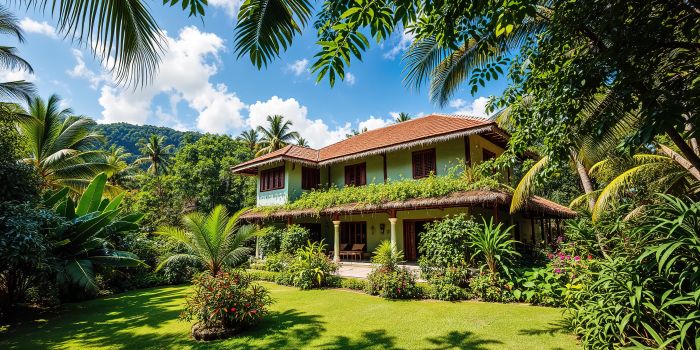
A restored colonial-era residence in the hills above Jacmel — deep eaves, wraparound verandas, and lush gardens typical of the city's 19th-century architectural vocabulary.
🏨
Hotel Florita Built 1888
Suggested: photo of the Hotel Florita's courtyard, terrace, or period interior
Hotel Florita — a UNESCO-listed historic monument that has welcomed guests since its 1999 reopening.
No building in Jacmel embodies this language more completely than the Hotel Florita. Built in 1888 during the height of the coffee trade, the Florita was originally the home and commercial premises of a wealthy Haitian plantation owner — the ground floor a counting house, the upper floors a residence of considerable elegance. It was sealed in 1950 when the coffee economy declined and wealthy Jacméliens departed for Port-au-Prince, remaining closed for nearly half a century. Reopened as a hotel in 1999, the Florita has retained virtually all of its original fabric: period furniture, exposed brick walls in what was once the coffee depot, a courtyard and terrace where guests still eat fresh fish caught by local fishermen that morning. UNESCO and the World Monument Foundation have listed it as a historic monument. It is, as one longtime visitor wrote, the Oloffson of Jacmel — a hotel that is simultaneously a place to sleep and a place to understand.
Beaches and the Blue Beyond
Jacmel's beaches deserve their own literature. The city is bracketed by coastline that ranges from the dark volcanic sand of the bay itself to the pale Caribbean white of the beaches at Cayes-Jacmel, and each beach carries its own character and constituency. Raymond des Bains, east of the city center, is the most celebrated — a broad stretch of sand popular with Haitian families during the summer season and with diaspora visitors returning for the holidays. Ti Mouillage, further east still, offers calmer water and a more intimate atmosphere. Kabik attracts a mix of local youth and adventure travelers. Each of these beaches is backed by the green hills that define Jacmel's southeastern coast, creating a visual setting of considerable drama.
For the visitor with a spirit of adventure, the Bassin Bleu pools — accessible by a short hike through lush tropical vegetation — offer a swimming experience that defies easy description. Three cascading pools of a blue so vivid it seems artificial, fed by waterfalls that emerge from the limestone hills above: the Bassin Bleu is, simply, one of the most beautiful places in Haiti, and by extension in the Caribbean. The neighboring Cascades Pichon and the natural fountain known as Le Trou — famous for its annual January festival — add further dimension to a natural landscape of exceptional richness.
The bay itself, sheltered and calm, was once the harbor from which Jacmel's great coffee fortunes departed for European markets. Today it receives fishing boats returning with catch for the city's restaurants. On clear evenings, the mountains behind the city turn purple as the light fails, and the bay holds the last of the colors before darkness comes.
Hospitality as Heritage
No account of Jacmel is complete without accounting for its people. The Jacmélien character — warm, creative, quietly proud, unhurried — shapes the visitor experience in ways that no tourism infrastructure alone could replicate. Hosts share meals. Artisans invite strangers into their workshops. Hotel managers with decades of memory recount, with evident feeling, the years when European and North American visitors came in numbers that filled the city's guesthouses.
Hotel Florita's manager Jean Ruid Sénatus, who has overseen that storied property for more than 30 years, speaks of the contrast between past and present with the dignified grief of someone who knows what a city is capable of and watches it waiting for the world to remember. In 2017, the Florita operated at 60 percent occupancy, mostly with visitors from Europe and North America. Recent years have been harder, as security challenges in transit routes have limited visitor flow. But the Florita remains open. The artisans remain at work. The carnival proceeds each February with its masks and its music and its refusal to be extinguished.
The accommodations that Jacmel offers range from the historic grandeur of the Florita to the cliff-perched Cap Lamandou Hotel, with its sweeping views of sea and mountain, to the quiet comfort of smaller guesthouses that offer the kind of intimate contact with local life that larger hotels can never provide. The cuisine — griot and fresh seafood, aromatic rice and beans, the strong Haitian coffee that once built this city's fortune — is available in small restaurants and from street vendors who understand that feeding people well is a form of hospitality too.
Travel Essentials | Jacmel
Getting There: Accessible by road from Port-au-Prince (approximately 2–3 hours) and by small aircraft to Jacmel Airport (Aéroport Antoine Simon). The road journey through the mountains, though sometimes challenging, offers spectacular scenery.
Where to Stay: Hotel Florita (Rue du Commerce) — a UNESCO-listed historic monument and Jacmel's most storied address. Cap Lamandou Hotel — cliff-side views with access to the historic district. Hotel Cyvadier — Caribbean comfort and local character.
Best Time to Visit: February for Carnival season (Mardi Gras). Summer months (July–August) for beach visits and the diaspora homecoming season.
Must See: Bassin Bleu natural pools, Place Toussaint Louverture, Rue du Commerce historic district, the Iron Market, papier-mâché artisan workshops, Raymond des Bains beach, and the Jacmel Carnival each February.
What to Bring Home: Papier-mâché masks and carnival figures, Haitian paintings from local galleries, handwoven baskets and textiles, artisanal jewelry, and Haitian coffee — the beans that built this city.
A City the World Should Know
Jacmel Waits for the World to Catch Up
Jacmel is not an easy story to tell in our current moment. Haiti faces challenges that are real and documented, and the violence that has affected transit routes to this city in recent years has had genuine consequences for the tourism economy that Jacmel's artisans and hospitality workers depend upon. These facts deserve acknowledgment, not evasion.
But they do not constitute the whole story — and the Haitian Business Journal does not traffic in the partial narrative. Jacmel is a city with 326 years of history, a UNESCO Creative City designation, an architectural heritage that influenced the look of New Orleans, a carnival tradition recognized as one of the most artistically significant in the Western Hemisphere, beaches of Caribbean splendor, and a community of artisans whose work hangs in galleries around the world. It is a city that has survived earthquake, fire, economic decline, and colonial extraction, and has emerged from each catastrophe still making art, still hosting carnival, still receiving visitors with the particular grace that is its inheritance.
For the Haitian diaspora — for the children and grandchildren of those who left Cap-Haïtien and Port-au-Prince and the southern departments and made new lives in New York and Miami and Montreal and Paris — Jacmel is a destination that carries the weight of identity. To walk its streets is to encounter Haiti not as a problem to be solved but as a culture of sovereign depth and beauty. To watch a papier-mâché artisan shape a crocodile mask from newsprint and patience is to witness a practice that has no equivalent anywhere in the world.
"Jacmel does not perform for visitors. It simply lives — fully, colorfully, creatively — and invites the world to bear witness."