
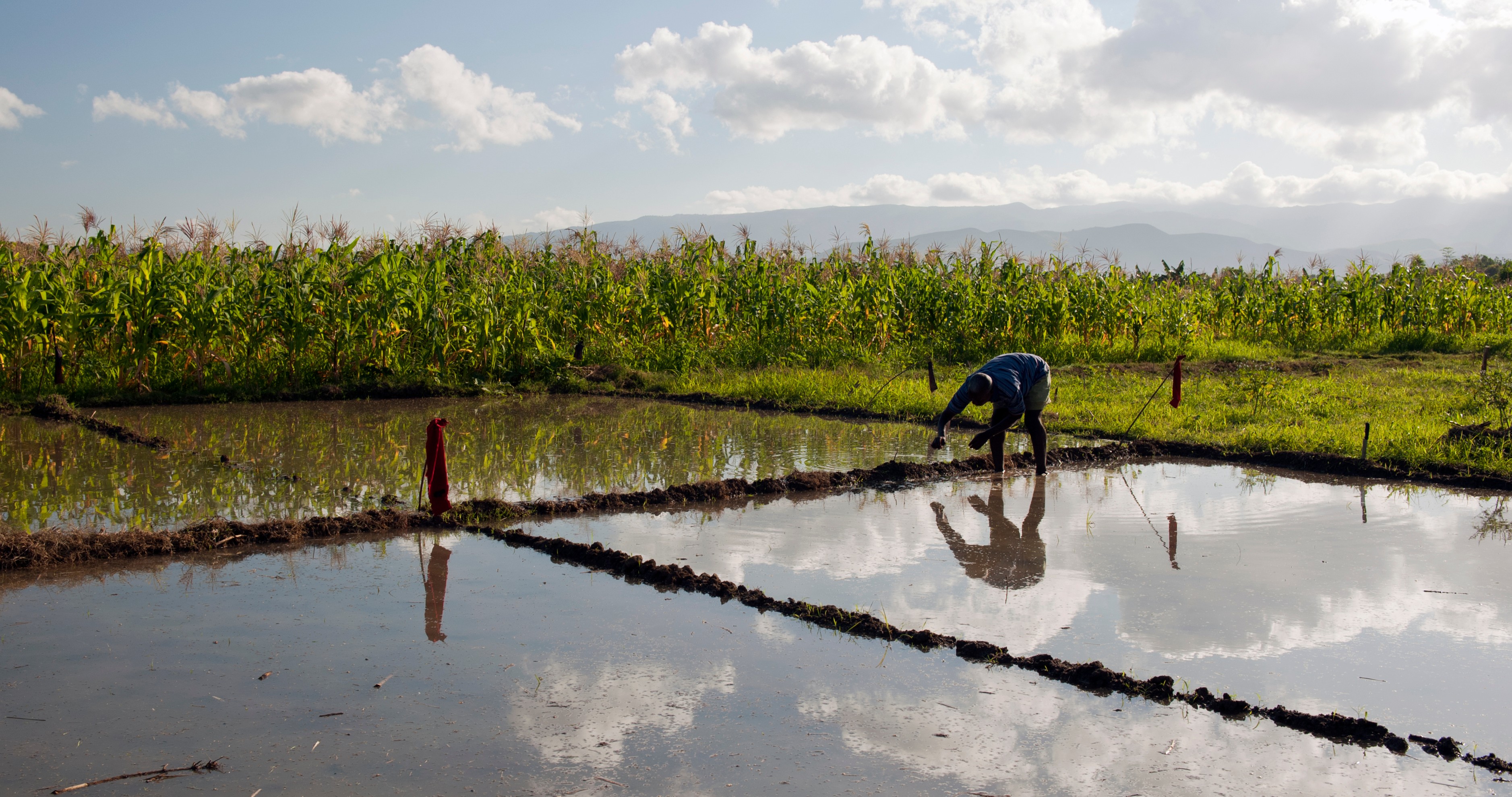
 onerror="this.src='https://upload.wikimedia.org/wikipedia/commons/thumb/3/30/2010_Haiti_earthquake_damage.jpg/1280px-2010_Haiti_earthquake_damage.jpg'"
alt="Rice fields in Haiti's Artibonite Valley">
onerror="this.src='https://upload.wikimedia.org/wikipedia/commons/thumb/3/30/2010_Haiti_earthquake_damage.jpg/1280px-2010_Haiti_earthquake_damage.jpg'"
alt="Rice fields in Haiti's Artibonite Valley">
Before there was a Republic of Haiti, before the guns fell silent at Vertières and the world's first Black nation declared itself free, there was the Artibonite. The river tumbled down from the mountains of the interior, fanning across the wide central plain in a network of channels and distributaries that transformed the valley floor into some of the most productive farmland in the Caribbean. The Taíno people who first cultivated those flats understood what they had. The French colonizers who followed understood it too, extracting enormous wealth from the valley's soils. And the Haitian peasant farmers who inherited the land after independence — stripped of the machinery, credit, and markets that might have made their work easier — understood it perhaps most deeply of all. For them, the Artibonite was not merely a resource. It was an identity. It was, in every sense of the phrase, the breadbasket of the nation.
Today, that breadbasket has been half-emptied. Gang violence, broken irrigation infrastructure, declining yields, foreign food dumping, and decades of policy failures have conspired to reduce one of the Caribbean's most promising agricultural regions to a shadow of what it once was — and what it could be. But the story of the Artibonite's decline is not a natural disaster. It is a political one. Understanding how it happened, who benefited, and who is now fighting back is essential to understanding Haiti's future.
The Valley That Fed a Nation: A History
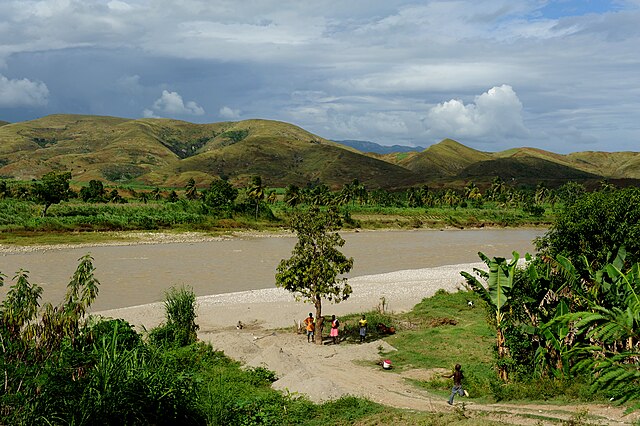
The Artibonite Valley, stretching across the department of the same name in west-central Haiti and fed by the Artibonite River — the longest river in the entire Caribbean — covers approximately 4,000 square kilometers of fertile, irrigable land. The valley floor, nourished by centuries of alluvial deposits and regulated since the 1950s by the Péligre Dam, was the agricultural engine of the Haitian economy for most of the nation's independent history.
Rice, introduced to the island during the colonial period, became the valley's signature crop. By the mid-twentieth century, the Artibonite was producing rice on a scale that made Haiti substantially self-sufficient in its staple food. A 1952–1953 survey estimated production at 64 million pounds annually from the valley's small paddies alone. The Organisme de Développement de la Vallée de l'Artibonite (ODVA), established to manage the region's irrigation networks and provide technical assistance to farmers, helped expand and coordinate that production for decades. At its peak, domestic rice output reached approximately 78,000 metric tons annually, and the Artibonite was responsible for producing more than 75–80 percent of it.
But rice was far from the only crop the valley produced. Maize, sorghum, beans, sweet potatoes, cassava, plantains, vegetables, and tropical fruits filled the fields and markets of the region. The Artibonite was genuinely diverse in its output, and the more than 1.5 million people who lived in and around the valley depended on that diversity for both nutrition and livelihood. Haitian rice, grown organically in the traditional way, was widely regarded as superior in flavor and nutritional value to the heavily processed, mass-produced American product that would eventually come to replace it. "The rice grown in Haiti is much healthier," observed Ninaj Raoul of Haitian Women for Haitian Refugees. "Ever since this [imported] rice has been coming in, there have been diabetes epidemics. People didn't used to have that much diabetes."
The Architecture of Destruction: Trade Liberalization and the "Death Plan"
To understand what happened to the Artibonite, one must understand the sequence of external interventions that, over roughly two decades beginning in the mid-1980s, methodically dismantled the protective structures that had allowed Haitian agriculture to survive in a global economy fundamentally rigged against it.
The first blow came not from Washington but from the internal politics of Haiti itself. In 1986, the popular uprising that finally dislodged the Duvalier dictatorship left the treasury looted and the country in desperate need of external financing. The International Monetary Fund stepped into that void, extending a $24.6 million loan, but with conditions. Those conditions required Haiti to slash the import tariffs that had been protecting its rice farmers from subsidized foreign competition. Rice tariffs, which had stood at 150 percent before the Duvaliers, were cut to 50 percent — still the lowest in the Caribbean at the time, but a significant opening. The United States, which held by far the greatest influence in IMF decision-making, simultaneously passed its 1985 Farm Bill, dramatically increasing subsidies to American rice growers. By 1987, fully 40 percent of American rice producers' profits were coming directly from the U.S. government.
The logic was as old as imperial trade: protect your own producers with subsidies at home while forcing open the markets of weaker nations abroad. Haitian farmers, receiving no equivalent state support, were suddenly competing against a product that was being paid for, in large part, by American taxpayers. American rice began flowing into Haitian ports. Haitian farmers, already operating with minimal credit access, no insurance, and crumbling irrigation infrastructure, began to struggle.
"Within less than two years, it became impossible for Haitian farmers to compete with what they called 'Miami rice.' The whole local rice market in Haiti fell apart as cheap, U.S. subsidized rice flooded the market. There was violence, 'rice wars,' and lives were lost."
— Dr. Paul Farmer, Partners in Health, on the aftermath of Haiti's forced tariff reductionsThe situation worsened dramatically in 1991. When a CIA-backed military coup led by General Raoul Cédras overthrew the democratically elected President Jean-Bertrand Aristide, the United States and the international community imposed trade embargos on Haiti that severed the flow of fertilizers, agricultural inputs, and capital that farmers depended upon. Domestic production collapsed. Into the void stepped American corporations. The U.S. company Erly Industries established its Rice Corporation of Haiti (RCH) in 1991 and in December 1992 signed a nine-year contract with the illegal Cédras government under interim Prime Minister Marc Bazin, guaranteeing the importation of at least 5.5 metric tons of American rice per month. By 1994, Erly Industries' rice sales in Haiti alone had reached $373 million. The people of Haiti were hungry. The people of Arkansas were thriving.
The Clinton "Devil's Bargain": Complicity or Conspiracy?
The decisive moment came in 1994. With the Cédras junta still in power and international pressure mounting to restore Haiti's democratic government, the Clinton administration positioned itself as the mediator that would bring Aristide home. What was less publicized at the time was the price of that mediation. As a condition of U.S. assistance in returning to power, Aristide was required to accept the IMF's Emergency Economic Recovery Plan, which included further cuts to import tariffs on rice and other agricultural products. The tariff on imported rice, already slashed to 35 percent from its original levels, was cut further, to a staggering 3 percent — the lowest of any nation in the Caribbean Community, whose members maintained a common external tariff of 25 percent on rice. U.S. rice could now be sold in Haiti for 30 to 50 percent less than locally grown product.
The beneficiaries of this policy were not hard to identify. Arkansas rice — processed and shipped by companies like Riceland Foods and Producers Rice Mill down the Mississippi River to New Orleans and then by container ship to Haitian ports — dominated the market almost immediately. Haiti, a country of barely 10 million people and the poorest nation in the Western Hemisphere, became one of the fifth-largest importers of American rice in the world. A single U.S. corporation, American Rice Inc., enjoyed what critics described as a near-monopolistic position in the Haitian market.
The defense offered by the Clinton administration and the IMF was the familiar language of development economics: lowering food prices would benefit Haiti's urban poor, who spent a disproportionate share of their income on staples. This argument contained a germ of statistical truth — urban retail prices did stabilize — but it utterly ignored the human and economic catastrophe being imposed on the rural majority. The 160,000 people who worked in Haiti's rice value chain were not mentioned in the IMF's cost-benefit calculations. The knock-on collapse of related agricultural industries — fertilizer suppliers, equipment vendors, millers, transport workers — was not factored in. The long-term dependency being created, the destruction of food sovereignty, the foreclosure of any path toward rural development, all of this was either unseen or unacknowledged.
"It may have been good for some of my farmers in Arkansas, but it has not worked. It was a mistake. I have to live every day with the consequences of the lost capacity to produce a rice crop in Haiti to feed those people, because of what I did."
— President Bill Clinton, before the Senate Foreign Relations Committee, March 2010In 2010, in the wake of Haiti's catastrophic earthquake, Clinton finally said publicly what critics had argued for fifteen years. Appearing before the Senate Foreign Relations Committee in his capacity as United Nations Special Envoy to Haiti, he delivered a remarkable mea culpa. "Since 1981," he said, "the United States has followed a policy, until the last year or so when we started rethinking it, that we rich countries that produce a lot of food should sell it to poor countries and relieve them of the burden of producing their own food, so, thank goodness, they can leap directly into the industrial era. It has not worked." He called the arrangement a "devil's bargain."
The apology, however genuine, changed nothing. The subsidies to Arkansas rice farmers continued. The 3 percent tariff remained in place. American rice kept arriving at Haitian ports in container ships. And as Clinton's critics noted, his confession was incomplete: he did not acknowledge the role of the CIA-backed coup, the deliberate use of Aristide's restoration as a bargaining chip for trade concessions, or the corporate beneficiaries whose profits had financed political relationships in Washington. The apology addressed the policy's consequences without fully accounting for the interests it served.

The Compound Injuries: What Came After the "Death Plan"
The tariff demolition of the mid-1990s was the original wound, but it was not the only one. Over the two decades that followed, the Artibonite's agricultural sector absorbed blow after blow, each compounding the damage of the last.
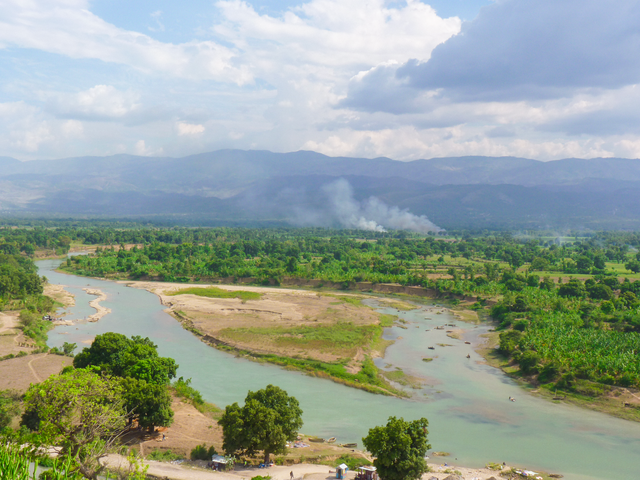
The valley's irrigation infrastructure, which depends on a network of canals fed by the Péligre Dam and the Artibonite River, fell into progressive disrepair. Without a viable rice economy to justify investment, the state found neither the political will nor the international financing to maintain the canal system. Waterlogging became endemic in parts of the valley, making fields prone to disease at harvest time, while other sections received too little water. Thousands of hectares that had once been productive lay fallow or produced far below their potential.
The natural disasters that periodically struck Haiti devastated what remained. Hurricane Sandy's rainfall caused $234 million in agricultural losses in 2012. Hurricane Matthew in 2016 inflicted hundreds of millions more. Each time, the lack of agricultural insurance, rural credit, and market infrastructure meant that farmers who lost a harvest did not rebuild, they abandoned their land. The rural exodus from the Artibonite to Port-au-Prince and to the diaspora accelerated, draining the valley of the human capital that had made its agriculture possible.
Deforestation in the surrounding mountains compounded the problem. Soil erosion from the denuded hillsides began silting up the irrigation canals and reducing the fertility of the valley floor. What had been a virtuous cycle — fertile soil, healthy harvest, farm income reinvested in land maintenance — became a vicious one. By the late 2010s, USDA estimates placed Haiti's rice yield at just 1.82 metric tons per hectare, significantly below regional averages and far below what modern farming techniques could produce on the same land.
Then came the gangs. The security crisis that engulfed Haiti after the assassination of President Jovenel Moïse in July 2021 reached the Artibonite with catastrophic force. Armed groups occupied vast stretches of agricultural land, extorting farmers — demanding payment before planting, seizing harvests, forcing families from fields that had been in their possession for generations. "Planters are trapped," said André Saint-Louis, coordinator of the Network of Organizations for the Integration of Planters in Bas-Artibonite. "The gangs make the laws here." By 2023–2024, USDA estimated that harvested rice area in the Artibonite had fallen to 55,000 hectares, some 5,000 hectares below the ten-year average, and production had dropped 19 percent below the five-year mean. A region that once proudly called itself Haiti's breadbasket was barely producing enough to feed itself.
The Full Damage: Artibonite Valley at a Glance (2024)
- Rice production estimated at 55,000 metric tons — down 19% from the 5-year average and the lowest level in over a decade
- Yield collapsed to 1.82 tons per hectare, 11% below the 5-year average, as gang activity prevents proper farming and input sourcing
- Harvested area dropped to 55,000 ha — roughly 5,000 hectares below trend as farmers flee armed groups
- Over 80% of rice consumed in Haiti is now imported, making the country one of the top five importers of American rice globally
- Haiti spent more annually servicing its IMF debt than it invested in agriculture or tourism
- Corn and sorghum production also declining, with corn down 2% year-over-year and 5% from the 5-year average
The Dominican Republic's Canal Controversy: Provocation and Unexpected Catalyst
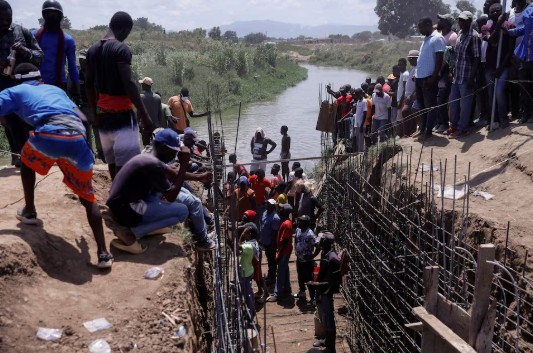
In August 2023, something unexpected happened. In the commune of Ouanaminthe in Haiti's northeast, on the banks of the Massacre River that forms the border between Haiti and the Dominican Republic, hundreds of Haitian farmers, civil society members, and volunteers resumed construction on an irrigation canal that had been stalled for years. The canal — originally designed in 2011 by the Cuban state-owned engineering company DINVAI — was intended to carry water from the river to irrigate the Maribaroux Plain, Haiti's second-largest rice-growing region, unlocking roughly 7,000 acres of fertile but currently parched land. The workers wore colorful hard hats and fluorescent vests. They chanted. They vigiled through the nights. On social media, the hashtag #KPK — KANAL LA PAP KANPE, meaning "the canal construction will not stop," went viral across the Haitian diaspora.
The Dominican Republic's reaction was swift and furious. Dominican President Luis Abinader, claiming the canal violated the 1929 Treaty of Peace, Friendship and Arbitration that governs the shared use of the Massacre River, ordered the complete closure of the entire Dominican border — land, sea, and air — on September 14, 2023. The decision was designed to economically pressure Haiti into halting construction. It had the opposite effect.
For Haitian farmers and the broader Haitian public, the Dominican reaction crystallized something that had long been felt but rarely so starkly demonstrated: Haiti's food dependence on the Dominican Republic was itself a form of vulnerability and subjugation. The Dominican Republic supplied a significant portion of Haiti's food imports, and the border closure immediately highlighted how deeply that dependency had cut into Haitian sovereignty. The lesson was visceral: a country that cannot feed itself cannot negotiate on equal terms with anyone — not with the Dominican Republic, not with the IMF, not with Arkansas rice brokers.
"Haitian farmers believe that the canal they are building symbolizes their future, a glimmer of hope, the recovery of their sovereignty, their dignity, and their food autonomy."
— New Lines Magazine, November 2023, on the Massacre River canal constructionThe Haitian government, under Prime Minister Ariel Henry, eventually asserted its position at the United Nations General Assembly in September 2023, affirming Haiti's right under the 1929 treaty to use the Massacre River for irrigation — just as the Dominican Republic had done for decades through its own five canals, multiple aqueducts, and dams on the same waterway. The legal argument was sound: the 1929 treaty explicitly states that "the waters of the rivers Libón and Artibonite belong equally to the two riparian States," and international water law endorses the principle of equitable and reasonable use. The Dominican Republic's position — that its neighbor had no right to the same resource it had been drawing from for generations — was widely regarded by international legal experts as legally and morally untenable.
The construction proceeded. And while the security crisis and political instability in Haiti have since complicated implementation, the Massacre River canal controversy had achieved something remarkable: it had turned food self-sufficiency into a matter of national pride, popular mobilization, and front-page international news. The Dominican reaction had inadvertently made the Haitian farmer a symbol of resistance and sovereignty. That psychological shift, however incomplete, matters enormously for what comes next.
The Farmers Fighting Back: Seeds of a New Artibonite
Despite the weight of the challenges bearing down on the Artibonite — the decades of policy betrayal, the crumbling infrastructure, the gang violence, the climate shocks — the farmers of the valley have not surrendered their claim on the land or their vision of what it could produce. Across the region and in the broader agricultural sector, a fragmented but real movement toward food sovereignty is taking shape.
One of the most significant technical interventions has been the adoption of the System of Rice Intensification (SRI), a set of agronomic practices that dramatically improve rice yields without requiring expensive inputs. USAID's Feed the Future program, working with roughly 1,500 farmers in Haiti's Artibonite since 2010, found that SRI adoption increased gross margin per hectare for rice farmers from $350 to $1,691 — nearly a fivefold increase. Oxfam America's Artibonite Valley Livelihoods Program has reinforced these gains, establishing revolving credit funds for agricultural inputs, rehabilitating irrigation canals, and training farmers in techniques that improve both productivity and resilience.
Solar-powered irrigation has emerged as a particularly promising technology. Since 2018, the Inter-American Development Bank (IDB) has funded Haiti's Agricultural and Agroforestry Technological Innovation Program (PITAG), executed through the Ministry of Agriculture, which has deployed 28 solar-powered irrigation pumps across the Plain of Gonaïves in the Artibonite Department. These pumps — managed by farmer-led committees organized into the FEPIPGO federation — have enabled greater crop diversification, with high-value horticultural crops now grown alongside traditional staples. The model is significant not only for its agronomic results but for its governance structure: Haitian farmers themselves are managing the infrastructure, collecting fees, resolving disputes, and building the institutional capacity that has so often been denied them.
Agricultural associations and cooperatives are multiplying across the valley. The Network of Organizations for the Integration of Planters in Bas-Artibonite, despite operating under the constant threat of gang extortion, has worked to organize farmers into collective structures that offer some negotiating power with buyers and access to inputs at volume discounts. Women farmers, who constitute the backbone of the Artibonite's agricultural workforce — handling much of the processing, marketing, and harvest labor — are increasingly central to these organizing efforts. Field research by Oxfam in the valley documented the extraordinary extent of women's participation, a resource that any serious agricultural renewal strategy must explicitly support and invest in.
At the national policy level, there are at least the beginnings of a recognition that the trade liberalization experiment has failed. Several studies by Haitian agronomic associations, including the Association Nationale des Agro-Professionnels Haïtiens (ANDAH), have called for a comprehensive national rice policy centered on infrastructure improvement, credit access, price stabilization mechanisms, and the kind of domestic market protection that nearly every successful agricultural economy in the world provides for its farmers. The question is not whether such a policy is technically feasible. It is. The question is whether any government capable of implementing it will emerge from Haiti's current political paralysis.
Pathways to Recovery: What the Artibonite Needs
- Comprehensive rehabilitation of the valley's irrigation canal network, estimated to cost tens of millions of dollars but capable of unlocking enormous productivity gains
- Reinstatement of meaningful import tariff protection for domestic rice — CARICOM maintains 25%; Haiti's 3% is indefensible on economic or equity grounds
- Establishment of rural agricultural credit facilities and crop insurance programs to protect farmers against climate shocks and market volatility
- Scaling of solar-powered irrigation technology (the IDB PITAG model) across the full 32,000 hectares of the valley's irrigated land
- Expansion of SRI adoption and agronomic extension services, with particular investment in women farmers who lead much of the valley's agricultural labor force
- Security restoration in gang-controlled agricultural zones — no farming recovery is possible while armed groups extort harvests and force farmers from their land
- Completion of the Massacre River canal to unlock the 7,000-acre Maribaroux Plain in northeastern Haiti
- Investment in rice processing and storage infrastructure to reduce post-harvest losses and improve the competitiveness of domestically grown product
A Reckoning Long Overdue
The story of the Artibonite Valley is, at its core, a story about power. The power of international financial institutions to impose conditions on desperate nations. The power of a subsidized agricultural sector in one country to eliminate the unsubsidized competition of another. The power of political relationships in Washington to shape policy outcomes 1,500 miles away in a Haitian rice field. And the power — stubborn, patient, and underestimated — of Haitian farmers who have refused to abandon the land even as everything was stacked against them.
Bill Clinton's famous apology was sincere, as far as it went. But sincerity is not restitution. The Arkansas rice that still arrives at Haitian ports in container ships, subsidized by American taxpayers and sold at prices that local farmers cannot match, is not made less damaging by a congressional hearing confession. The 3 percent tariff that has governed Haitian rice imports for more than thirty years has never been raised. The Farm Bill subsidies that gave American rice its market advantage in Haiti are still in place. The apology changed the narrative. It did not change the terms of trade.
What has changed is the Haitian farmer's relationship to the question of food sovereignty. The Massacre River canal, with its viral hashtag and its hundreds of volunteer workers in hard hats donated by the diaspora, demonstrated something that decades of donor reports and development conferences had failed to communicate as vividly: Haitian farmers know exactly what they need, they are willing to build it themselves, and they understand that their dignity and their country's future depend on it. That the Dominican Republic's disproportionate reaction to a modest irrigation project galvanized international attention and domestic mobilization simultaneously was an irony that history will note with some satisfaction.
The Artibonite Valley remains, beneath the gang violence and the broken canals and the decades of policy failure, what it has always been: one of the most naturally productive agricultural regions in the Caribbean, blessed with rich alluvial soil, a powerful river, and a climate that allows year-round cultivation of multiple crops. The valley's farmers have survived Duvalierism, military coups, IMF structural adjustment, import dumping, hurricanes, earthquakes, and armed occupation. Their capacity for endurance is not the problem. The problem is that endurance alone is not enough.
Haiti needs trade policy that protects its farmers the way the United States protects its own. It needs irrigation infrastructure maintained the way France maintains the Camargue. It needs credit markets and crop insurance the way Brazil's Embrapa system supports its smallholders. It needs, in short, what every agricultural economy in the developed world already has and takes for granted, and what has been denied to Haiti through a combination of historical injustice, creditor conditions, and deliberate policy choices made by people who were not Haitian and would not live with the consequences.
The Artibonite fed Haiti for centuries. Given half the chance, it can do so again.
Sources and further reading: This article draws on reporting and research from Foreign Policy, Democracy Now!, Partners in Health, the World Hunger News Service, the Council on Hemispheric Affairs, the USDA Foreign Agricultural Service, the Inter-American Development Bank, Oxfam America, Wikipedia's Rice Production in Haiti, the Harvard International Law Journal, New Lines Magazine, FEWS NET, and the Haiti Times. All figures cited are from publicly available sources. The characterization of U.S.-Haitian trade policy in this article reflects the editorial position of the Haitian Business Journal and does not constitute legal advice or investment guidance.